

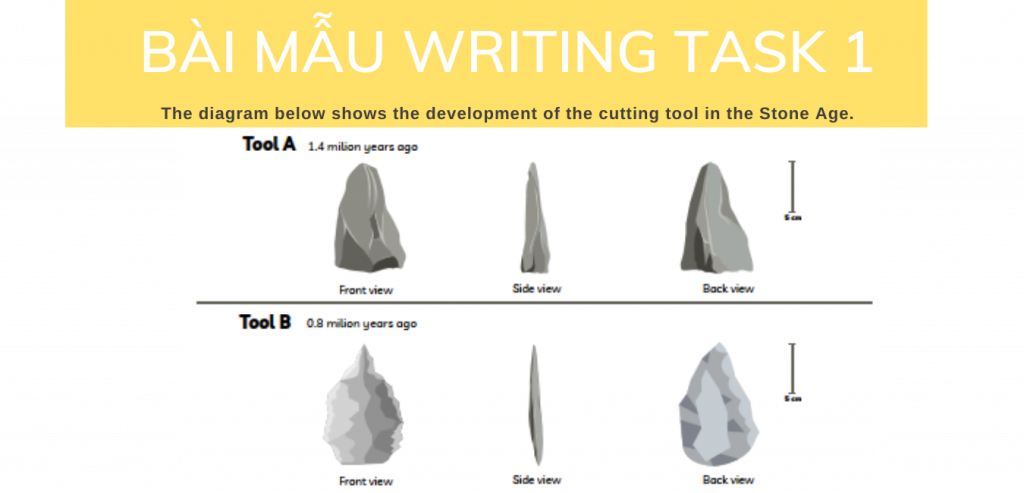
Đề bài như sau: The diagram below shows the development of cutting tools in the Stone Age. Summarize the information by selecting and reporting the main features, and make comparisons where relevant.
Dạng bài Diagram/Process luôn là dạng bài khá khó Writing Task 1 gây nhiều lo lắng cho các bạn sĩ tử.
Với bài này ta thấy:
- Có nhiều sự thay đổi
- Thay đổi lớn nhất là sắc hơn và nhọn hơn.
Bài mẫu
The illustration details the evolution of stone cutting tools used by prehistoric men in the Stone Age.
As is evident from the diagram, the key difference between the cutting tools in the two periods is the size, with the latter version becoming noticeably larger. Tool B also appears more refined than tool A in terms of shape and sharpness.
1.4 million years ago, the cutting tool was thin, measured 7-8 centimeters in length, and did not display much craftsmanship. They were also rather uneven in appearance: the front and the back were shaped differently, and the surface appears to have been quite rough.
600,000 years later, it is obvious that the cutting tools used by man in the Stone Age had become significantly more advanced. First of all, they were larger, measuring 10-11 centimeters in length, and had a more definite tear-drop shape: fat at the base and tapering aggressively toward a sharp tip whereas the prior versions tended to be obtuse. Second, both front and back sides were ground more evenly and smoothly. It would also seem that man had learnt to sharpen the sides of their cutting tools as well.
Từ vựng
- to detail: làm rõ
- refined (adj) trau chuốt
- craftsmanship (n) sự khéo léo
- uneven (>< even) (adj) không cân đối
- advanced (adj) nâng cao, phát triển
- tear – drop (n) hình giọt nước
- to taper: vuốt, thon về
- obtuse (adj) cùn, tù
- to grind: mài